Publication Date: January 20, 2026
Print Length: 427 pages
- Best Books of the Year So Far 2026, Amazon
- Kirkus 20 Best Books of January
- Book Page’s Top 10 books of the Month
PREVIOUS AUTHOR PUBLICATIONS
- Kiki Man Ray: Art, Love and Rivalry in 1920s Paris
- The Invisible Emperor, Napoleon on Elba from Exile to Escape
- Making Monte Carlo, A History of Speculation and Spectacle
SYNOPSIS
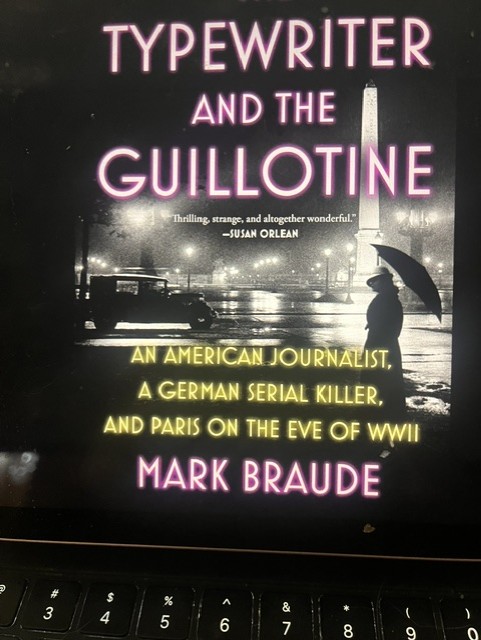
In this portrait of Paris in the late 1930s, historian Mark Braude weaves the stories of Janet Flanner, who wrote columns for The New Yorker, and Eugen Weidmann, a serial killer who was publicly executed.
While Flanner’s column, “Letter from Paris,” was initially lighthearted and humorous when it debuted in 1925, it took a darker turn as Hitler’s geopolitical ambitions became clearer. As the threat of war loomed, the highly publicized 1939 trial of Eugen Weidmann, a German conman became a portent of the tumultuous wartime world that was beginning to emerge.
REVIEWS AND AUTHOR INFORMATION
MacNicol, Glynnis, “The writer who defined 1920s Paris? It wasn’t Hemingway.” The New York Times, January 22, 2026. Book Review: ‘The Typewriter and the Guillotine,’ by Mark Braude – The New York Times
Duffy, Bob, “The Typewriter and the Guillotine: An American journalist, a German serial killer and Paris on the eve of WWII.” Washington Independent Review of “Books, February 9, 2026. The Typewriter and the Guillotine: An American Journalist, a German Serial Killer, and Paris on the Eve of WWII | Washington Independent Review of Books
Mulson, Jennifer, “Review: A WWII serial killer in “the Typewriter and the Guillotine.” The Gazette, February 19, 2026. Review: A WW II serial killer in ‘The Typewriter and the Guillotine’ – Colorado Springs Gazette
Groply, Lim, “Book review: ‘The Typewriter and the Guillotine,’ by Mark Braude, Book Release & Reading Picks, January 22, 2026. Book Review: ‘The Typewriter and the Guillotine,’ by Mark Braude – Book Releases & Reading Picks | pageturnernews.com
DISCUSSION QUESTIONS
What was your reaction as Braude shifted between describing Janet Flanner’s life in Paris and the crimes and eventual murder trial of Eugen Weidmann?
As a historian, what resources was Braude able to access as he created a fact-based history of Janet Flanner’s life while detailing the crime spree of Eugen Weidmann?
What were the differences between how Janet Flanner, an American, reacted to the ominous signs of war as compared to the residents of Paris?
In what ways did Flanner consider herself to be an observer rather than a journalist? How did Flanner’s column shift as signs of war became more imminent?